Article Outline
- H1: Understanding Spam Score
- H2: What Is Spam Score?
- H3: Who Created Spam Score?
- H3: Is Spam Score a Google Ranking Factor?
- H2: How Spam Score Works
- H3: The 27 Spam Signals
- H3: How Moz Calculates Spam Score
- H2: Spam Score Ranges Explained
- H3: Low Spam Score
- H3: Medium Spam Score
- H3: High Spam Score
- H2: Common Reasons for a High Spam Score
- H3: Poor Backlink Profile
- H3: Thin or Low-Quality Content
- H3: Spammy On-Page SEO Practices
- H2: How to Check Your Website’s Spam Score
- H3: Best SEO Tools
- H2: How to Reduce Spam Score
- H3: Audit Your Backlinks
- H3: Improve Website Quality
- H3: Build High-Quality Backlinks
- H2: Best Practices to Maintain a Healthy Spam Score
- H2: Conclusion
- H2: Frequently Asked Questions
- H2: What Is Spam Score?
Understanding Spam Score
If you’ve ever used an online SEO tool like Moz, you’ve probably come across the term website Spam Score. For many website owners, seeing a high percentage can be harmful. Does it mean Google is about to penalize your website? Should you need to remove backlinks immediately ? Or is Spam Score simply another SEO metric that needs proper interpretation?
The reality is somewhere in between. Spam Score is not a Google metric. It is a proprietary metric developed by Moz to estimate how closely a website resembles domains that have historically been penalized or banned by Google. It serves as an early warning system rather than a direct indicator of ranking performance. SEO experts widely recommend using it as one of several metrics when evaluating website quality, backlink opportunities, and potential SEO risks – not as the only factor.
In this comprehensive guide, you’ll learn exactly what Spam Score is, how it works, what causes it to increase, and the proven methods to reduce it while building a stronger SEO foundation.
What Is Spam Score?
Spam Score is a percentage-based metric ranging from 1% to 100% that estimates the likelihood a website displays characteristics commonly associated with spammy or penalized sites. Unlike Google’s internal systems, Spam Score is created and maintained by Moz using machine learning and historical data from websites that have received search penalties.
One of the biggest misconceptions among beginners is believing that Google directly uses Moz’s Spam Score to rank websites. That is incorrect. Google has never confirmed using this metric. Instead, Google relies on its own sophisticated systems, including SpamBrain, to detect spam and low-quality content. While the underlying signals may overlap – such as unnatural backlinks or thin content – the numerical Spam Score itself has no direct impact on search rankings.
Think of Spam Score like the warning light on your car’s dashboard. The light doesn’t damage your engine; it simply alerts you that something deserves attention. Likewise, a high Spam Score doesn’t automatically mean your website is in danger, but it signals that you should investigate your backlink profile, content quality, and technical SEO.
Who Created a Spam Score?
Spam Score was developed by Moz, one of the leading SEO software companies. The metric was designed to help marketers quickly identify websites that may pose risks when building backlinks or conducting SEO audits. Moz continually updates its model to improve prediction accuracy based on new data and evolving search trends.
Is Spam Score a Google Ranking Factor?
No.
This is perhaps the most important takeaway. Google representatives have repeatedly indicated that third-party metrics – including Domain Authority and Spam Score – are not ranking factors. They are useful estimates created by SEO platforms to help professionals prioritize audits and identify patterns worth reviewing.
Read Related – Effective Ecommerce SEO Strategies for Success
How Spam Score Works
Spam Score isn’t assigned randomly. It is calculated by analyzing numerous signals that frequently appear on websites considered spammy. Modern versions of the metric evaluate 27 different spam signals, ranging from backlink characteristics to on-page quality indicators.
The system looks for patterns rather than isolated problems. For example, having a single weak backlink won’t necessarily increase your Spam Score significantly. However, if your website has hundreds of backlinks from irrelevant websites, duplicated content, excessive outbound links, poor trust signals, and low-quality pages, the combined effect may substantially raise the score.
The 27 Spam Signals –
Some commonly evaluated factors include:
- Low-quality or unnatural backlinks
- Excessive outbound links
- Thin or duplicate content
- Poor website structure
- Suspicious anchor text patterns
- Weak trust signals
- Domain-related characteristics associated with spam
These indicators work together to estimate the overall risk rather than confirming that a website is actually engaging in spam.
How Moz Calculates Spam Score
Moz compares websites against patterns found in previously penalized domains. Machine learning models analyze these similarities and assign a percentage score representing estimated risk. Since this process is predictive rather than definitive, manual review is always recommended before making SEO decisions like disavowing backlinks.
Spam Score Ranges Explained
Understanding the number is just as important as checking it.
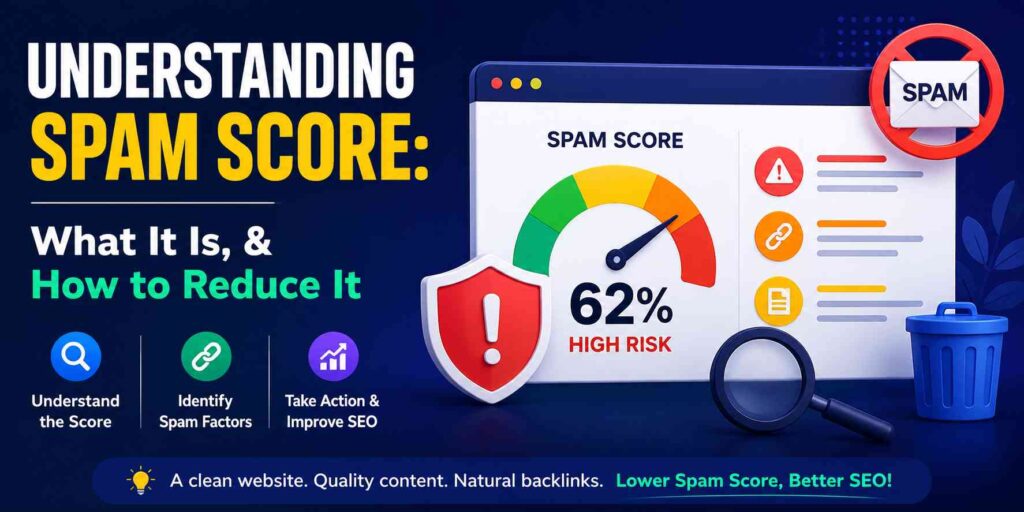
| Spam Score | Risk Level | Recommended Action |
| 1–30% | Low Risk | Continue monitoring and building quality links. |
| 31–60% | Moderate Risk | Review backlinks, content quality, and technical SEO. |
| 61–100% | High Risk | Conduct a complete SEO audit and investigate spam signals immediately. |
These ranges should be treated as guidelines rather than strict rules. Many legitimate websites may temporarily fall into the medium range due to backlink fluctuations or site changes.
Low Spam Score
A low Spam Score generally indicates your website has relatively few characteristics associated with spam. This doesn’t guarantee perfect SEO health, but it suggests that your backlink profile and website quality appear trustworthy from Moz’s perspective.
Medium Spam Score
A medium score deserves attention but not panic. Review recent backlinks, inspect newly indexed pages, and ensure your content remains valuable and original.
High Spam Score
A high score signals the need for a comprehensive audit. Instead of immediately disavowing links, investigate whether the backlinks are genuinely harmful, relevant, and capable of affecting your site’s trustworthiness. Many SEO professionals caution against making decisions based solely on Spam Score.
Common Reasons for a High Spam Score
A high Spam Score doesn’t happen overnight. It is usually the result of multiple SEO issues that accumulate over time. Search engines – and SEO tools like Moz – look for patterns rather than isolated incidents. If your website exhibits several characteristics commonly found on spammy domains, your Spam Score may increase even if your intentions are completely legitimate. This is why regular SEO audits are essential. Instead of focusing on the percentage alone, you should identify the root causes and address them systematically. Improving your website’s credibility requires strengthening every aspect of your SEO strategy, including backlinks, content, user experience, and technical performance.
Poor Backlink Profile
The most common reason for a high Spam Score is an unhealthy backlink profile. Backlinks remain one of the strongest signals for search engines, but not all links are beneficial. Links from unrelated websites, private blog networks (PBNs), link farms, hacked websites, or directories created solely for SEO purposes can raise concerns. Even if you didn’t intentionally build these links, they can still appear in your backlink profile through negative SEO attacks or outdated link-building practices.
Quality always outweighs quantity. A website with 100 backlinks from authoritative, relevant sources is generally in a much stronger position than one with 10,000 links from low-quality domains. Regularly reviewing your backlink profile using trusted SEO tools helps identify suspicious links before they become a larger issue. If harmful links are discovered, try contacting the linking website for removal. Only consider Google’s Disavow Tool after a careful evaluation, as unnecessary disavows can remove valuable link equity.
Thin or Low-Quality Content
Content quality plays a significant role in overall website trust. Pages with very little useful information, duplicate content, keyword stuffing, automatically generated articles, or outdated information can contribute to spam-like characteristics. Visitors expect helpful, original, and accurate content that answers their questions comprehensively. When pages fail to meet those expectations, search engines may view the website as offering limited value.
Instead of publishing large numbers of short articles, focus on creating fewer but higher-quality resources. Comprehensive guides, tutorials, case studies, original research, and expert opinions generally perform much better over time. Updating older content with fresh statistics, improved formatting, and current information also strengthens your website’s authority while reducing signals associated with low-quality content.
Spammy On-Page SEO Practices
Years ago, excessive keyword usage and manipulative SEO tactics sometimes produced short-term ranking gains. Today, those same techniques often have the opposite effect. Over-optimized title tags, repetitive anchor text, hidden keywords, doorway pages, excessive advertisements, and misleading redirects can all reduce your website’s perceived quality.
A well-optimized page should feel natural to readers first and search engines second. Use keywords where they genuinely improve relevance, but avoid forcing them into every sentence. Focus on readability, logical structure, fast page speed, mobile usability, and helpful internal linking. Modern SEO rewards websites that provide excellent user experiences rather than those attempting to manipulate algorithms.
How to Check Your Website’s Spam Score
Checking your website’s Spam Score should become part of your routine SEO maintenance. Fortunately, several reliable SEO platforms provide insights into backlink quality, domain health, and spam-related indicators. While Moz is the original creator of Spam Score, comparing results across multiple SEO tools often provides a more complete picture of your website’s authority and potential risks.
Begin by entering your domain into Moz Link Explorer. The tool displays your current Spam Score, backlink profile, linking domains, and various authority metrics. Rather than checking only your homepage, review important landing pages individually because some sections of your website may attract more problematic backlinks than others.
Other popular SEO platforms such as Ahrefs, SEMrush, and Google Search Console complement Moz’s data. Although they do not provide Moz’s Spam Score, they offer valuable insights into toxic backlinks, manual actions, indexing issues, crawl errors, and referring domains. Combining data from multiple sources allows you to make informed SEO decisions instead of relying on a single metric.
When reviewing your backlink profile, pay attention to:
- Sudden spikes in backlinks.
- Links from irrelevant or foreign-language websites.
- Excessive exact-match anchor text.
- Links from deindexed or suspicious domains.
- Large numbers of sitewide footer or sidebar links.
Monitoring these factors regularly helps prevent small issues from becoming major SEO problems.
How to Reduce Spam Score
Lowering a high Spam Score requires patience and consistent SEO improvements rather than quick fixes. There is no single button that instantly reduces the score because it reflects the overall health of your website. Instead, focus on building long-term trust with both users and search engines.
Audit Your Backlinks
Start with a comprehensive backlink audit. Export your backlink profile and categorize links into high-quality, neutral, and potentially harmful groups. Examine the relevance, authority, and context of each referring domain. Not every low-authority website is spammy, and not every high-authority website automatically provides valuable links.
If you identify clearly manipulative or malicious backlinks, request removal whenever possible. Google’s Disavow Tool should only be used when there is strong evidence that harmful links could affect your site’s performance. Most websites naturally accumulate some low-quality backlinks over time, and Google is generally effective at ignoring many of them.
Improve Website Quality
Content improvements often have a positive effect on your website’s overall trustworthiness. Review every important page and ask whether it genuinely helps visitors. Remove duplicate pages, consolidate overlapping articles, expand thin content, and update outdated information with recent statistics and examples.
User experience is equally important. Improve page loading speed, fix broken links, optimize images, enhance mobile responsiveness, and simplify navigation. Visitors who can easily find reliable information are more likely to stay longer, engage with your content, and share it naturally.
Build High-Quality Backlinks
The best way to offset poor backlinks is by consistently earning excellent ones. Focus on creating content worth referencing, such as detailed guides, original research, industry surveys, infographics, and practical tutorials. These resources naturally attract links from reputable websites over time.
Ethical link-building strategies include:
- Guest posting on authoritative industry websites.
- Digital PR campaigns.
- Publishing original research and statistics.
- Building relationships with industry experts.
- Creating shareable visual content.
- Earning mentions through valuable contributions to your niche.
Natural, editorial backlinks remain one of the strongest indicators of website authority and trust.
Best Practices to Maintain a Healthy Spam Score
Maintaining a low Spam Score is easier than recovering from a high one. Consistent SEO maintenance reduces risks and keeps your website healthy over the long term. Rather than chasing shortcuts, invest in sustainable optimization practices that prioritize quality and user satisfaction.
Here are some proven best practices:
- Publish original, well-researched content regularly.
- Monitor backlinks every month.
- Remove or update outdated pages.
- Keep plugins, themes, and software updated.
- Improve Core Web Vitals and page speed.
- Use natural anchor text.
- Avoid buying backlinks.
- Earn links from relevant, authoritative websites.
- Fix crawl errors and broken pages.
- Perform regular technical SEO audits.
Remember that SEO is an ongoing process. Websites evolve, competitors change strategies, and search engines continually update their algorithms. Regular monitoring helps you identify potential issues before they impact your site’s overall health.
Read Related – How to Effectively Lower Your Spam Score in 5 Easy Steps
Conclusion
Understanding Spam Score is essential for anyone serious about improving their website’s SEO performance. While the metric itself is not used by Google as a ranking factor, it provides valuable insight into patterns that may indicate potential quality or backlink issues. Rather than viewing Spam Score as something to fear, think of it as an early warning system that encourages proactive website maintenance.
A healthy website is built on valuable content, ethical SEO practices, strong technical foundations, and natural backlink growth. By conducting regular audits, publishing high-quality content, earning trustworthy backlinks, and avoiding manipulative SEO tactics, you can maintain a low Spam Score while strengthening your website’s long-term search visibility. Success in SEO isn’t about chasing perfect metrics – it’s about consistently delivering value to users and building genuine authority over time.
Frequently Asked Questions
1. What is a good Spam Score?
Generally, a Spam Score between 1% and 30% is considered low risk. However, the score should always be evaluated alongside other SEO metrics such as backlink quality, organic traffic, and domain authority.
2. Does Google use Moz Spam Score?
No. Google does not use Moz’s Spam Score as a ranking factor. It relies on its own systems to evaluate website quality and detect spam.
3. Can a high Spam Score hurt my rankings?
A high Spam Score itself does not directly affect Google rankings. However, the issues that contribute to a high score—such as poor backlinks or low-quality content—can negatively impact SEO performance.
4. How often should I check my Spam Score?
Checking your Spam Score once a month is sufficient for most websites. If you’re actively building backlinks or experiencing ranking fluctuations, consider monitoring it more frequently.
5. What’s the fastest way to lower Spam Score?
The most effective approach is to audit your backlink profile, remove or disavow genuinely harmful links when necessary, improve content quality, fix technical SEO issues, and continue earning high-quality backlinks naturally.